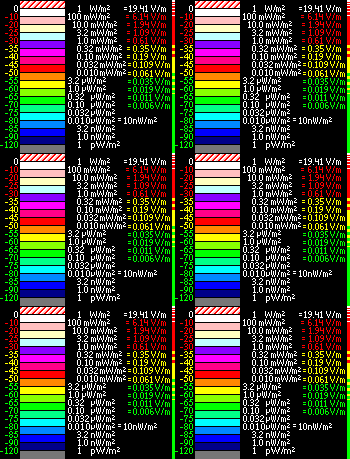
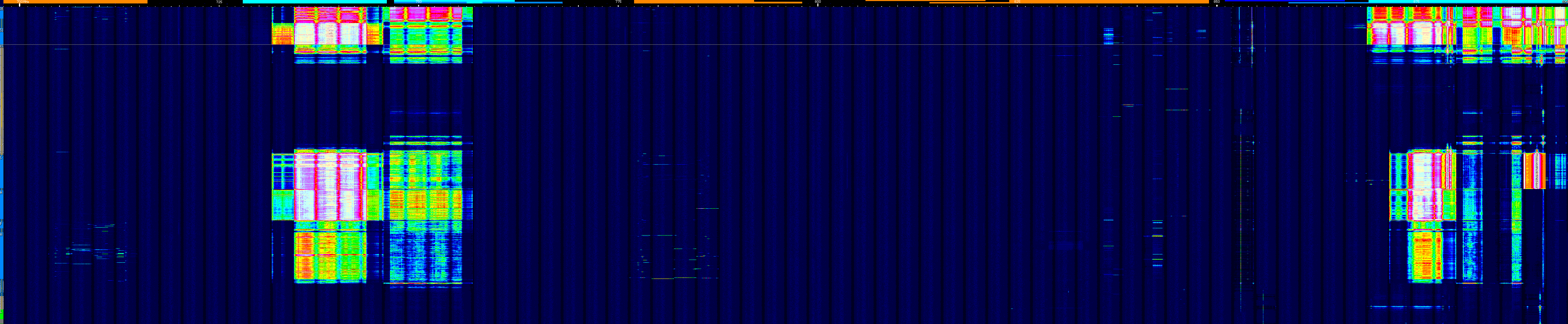
Note: The waterfall graphs below cover a frequency range from 0 to 6500Mhz, but the antenna used is only for 700 to 6000Mhz
Please ignore the apparant signal strength below 700Mhz, but it is still interesting to see the relative changes for location and nearby equipment.
For the graphs below:
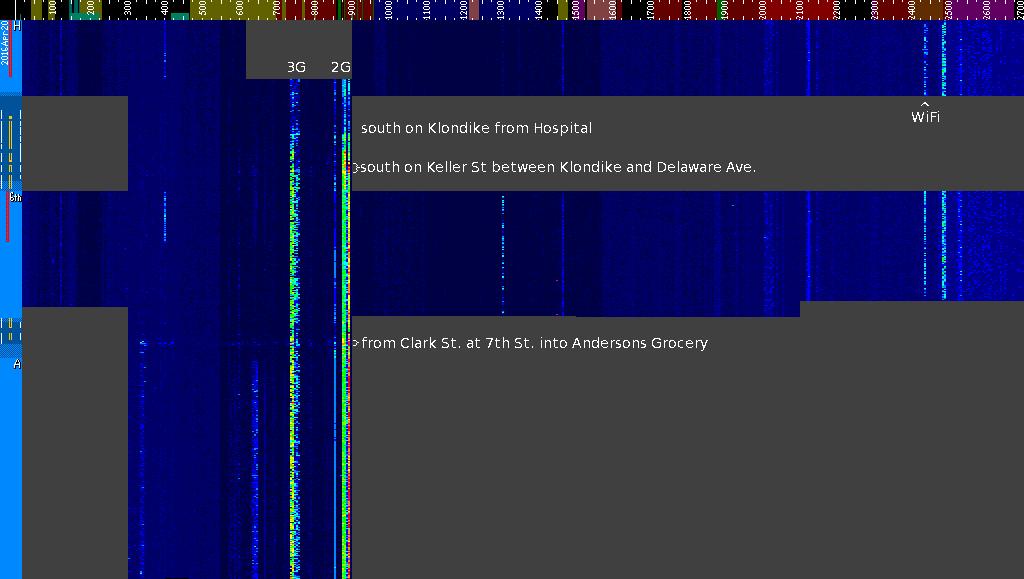
The far left column shows time index, location, and what known EMF sources were nearby, or when the Spectran antenna was itself shielded, (orange on grey).
The first row has pulse mode off. Notice the blacker field, or less signals detected. The results shown in this configuration (or mode) are the most accurate for measuring actual power density and detected signals.
Blue background
denotes away from home. Going thru town or past towers.
Pink background is from when I was getting elevated readings on my Zap Checker, but could not find the corresponding signal on the Spectran.
2006.March
From 0 Mhz to 3000 Mhz, 3Mhz bandwidth, PulseMode on for 29 of 33 recordings
Equipment upgrade due to problem with DC power plug. Still Rev.2
You may notice the signal strength below 700MHz is different. Again, it is to be disregarded as above for the same reason, the hyperlog antenna is only calibrated above 700 Mhz.
2006.May 2006.July
The spikes when driving by new towers is clearly seen here. 2009.May - Jun 2010.Apr
Flashed a new firmware version, and the noise floor changed, or more.
From 3500 Mhz to 6000 Mhz, 3Mhz bandwidth, PulseMode on 2006.March 2006.May 2006.July 2009.May 2010.Apr
(please note, PulseMode turns off Phantom filtering. Thus aliases, or echos at 20Mhz from actual signal may show up.)
However, due to the nature of pulsed digital signals, PulseMode is required to see them.
Preliminary conclusions:
The background radiation is growing/increasing year by year. We can feel it, even here. Here are attempts to graph and document the current situation, with numbers.
TV stations are 90 miles away. Calibration of meter below 700Mhz is not guaranteed. Therefore strength of low frequency signals is not certain with this equipment.
Medium signals from within 9 miles:
1700-1850Mhz PCS and GSM celphones
5800-5900Mhz Wireless internet or Wlan
Medium signals that blanket entire area from great distances:
various Radar
4300Mhz Aircraft radar altimeter
Colville
Very noisy and painful to be around now.
Various wireless phones, wlan, point 2 point.
traveled to Marysville
870Mhz, 1900Mhz, 2800Mhz, 3600Mhz Towers and masts can be seen, much louder than background.
Since the above was written, I have become aware of unfavorable reports from testing of the Aaronia Spectran. Also after writing to Aaronia myself about trying to decipher the signals detected, I have concluded the above measurements are not accurate enough to rely on, without being an expert myself in using the equipment properly, and they insist I read the manual, as if I have not several times!
However, I do think the above graphs are useful as an indicator of overall noise level in the air, and as a comparison between multiple locations.
Since Aaronia has a 10 year replacement warranty, I hope they release a more accurate version within that time.
I have the Revision 2 model. I am not getting the Revision 3 model, as there are reports that it is not better.
The fact I am getting the same "background" levels across all locations, including deep in the Cascade mountain range far from known towers, leads me to disregard the consistant lines as non-existant. Unfortunately, only looking at the changes from place to place, is not a good way to determine actual power density levels.
Since the above no longer compares to previous years, (see 2006.July for most relevant comparison) I will change from 3 MHz bandwidth to 1, increasing the resolution. One or two anomolies in the above graphs are at 1046 and 1206 MHz, for which I have no good explanation yet.
From 30 to 3000 MHz or 700 to 3000 MHz, 1Mhz bandwidth
amp OFF NonPeak
Sep.27 Republic
Oct.01 Spokane parking garage
Nov.08 Republic
PEAK on
Tonasket
Nov.08 3 miles Republic
amp ON PEAK on
Oct.01
Airway Heights
R49 to Republic
Oct.07 8 miles: Republic to Flag Rd
Oct.25
NonPeak
Oct.01 Spokane parking garage
From 3000 to 6000 MHz, 3Mhz bandwidth
amp OFF NonPeak Republic
PEAK on
From 3000 MHz to 6000 MHz, 1MHz bandwidth
amp OFF NonPeak
Oct.25 Republic
PEAK on
Tonasket
Nov.08 14 miles Republic to Lambert
amp ON
Peak ON Oct.07 Tonasket
24 miles: Scatter Creek to Republic to Lambert Creek
Oct.25 Republic
Some unanswered questions:
Why are the data points lower in strength with the Amplifier ON?
At least it does increase the contrast, which should make it easier to pick out the real signals nearby.
And why is there so little change when I drive through town or past transmitters that show up on other meters quite clearly?
Case in point, aiming at a celphone, at 827Mhz I do see a spike up from -72 dBm to -55 dBm.
Barely perceptable on the Spectran. I would expect to see more than a few blips.
When I changed the bandwidth to 3Mhz, the Spectran was flat at -68 dBm, and showed nothing, while the Acoustimeter loudly announced the phone was transmitting. I am not impressed.
2010.Jun. Aaronia's response, Why do you think its working in the GSM900 range? Propably its using the GSM1800 or UMTS i think thats simply the problem
2011.Dec. Yes it took me over a year to learn the Samsung debug codes, so that now I can prove what frequency the closest cell phone tower here is using. ARFCN 0142 is GSM850 on an uplink frequency of 827.0 Mhz. So my original question IS valid. As the receiving tower is 7 miles away, I have a hard time believing the Spectran's reading is the most accurate in measuring the cell phone transmitting power level.